How to Read Your WAPDA Bill for Solar Sizing — Step by Step Guide 2026
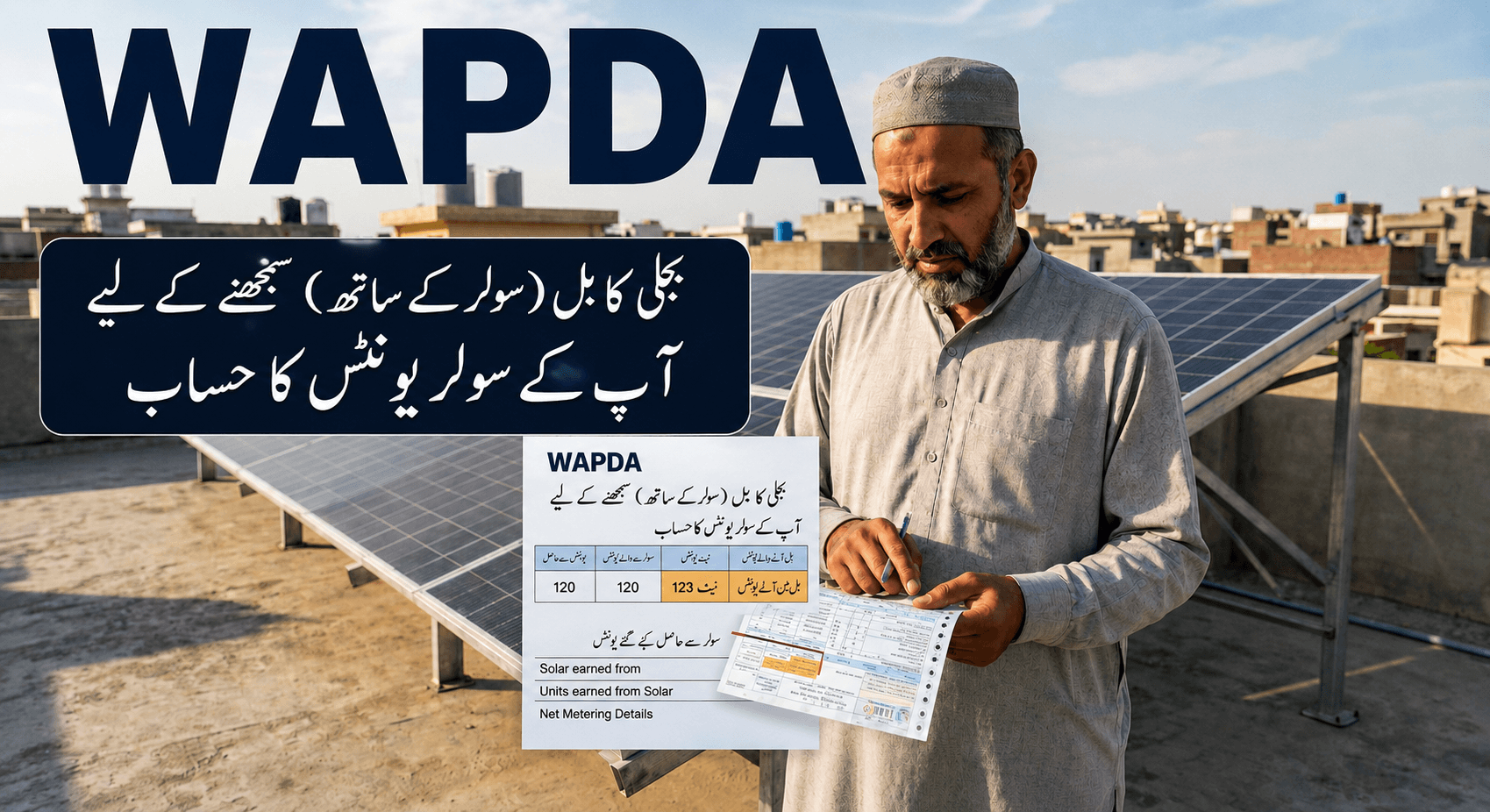
The fastest way to know what size solar system you need is sitting in your drawer right now: your WAPDA electricity bill. Most people only look at the "amount payable" number and miss the most important data points. In this guide, we break down every section of a Pakistani electricity bill and show you exactly how to use it to size your solar system correctly.
آپ کا بجلی کا بل آپ کو بتاتا ہے کہ آپ کو کتنے کلوواٹ کا سولر سسٹم چاہیے — بس آپ کو صحیح جگہ دیکھنا آنا چاہیے۔
The 3 Numbers That Matter for Solar Sizing
Ignore the due date, meter number, and fine print. For solar sizing, you need exactly three numbers from your bill:
- Monthly Units Consumed (kWh) — The most important number. Usually labeled "Units" or "kWh" near the top of your bill.
- Sanctioned Load (kW) — The maximum load DISCO has approved for your connection. Important for net metering applications.
- Consumer Category — Protected (under 200 units/month for 6 months) vs Non-Protected. This tells you your tariff slab.
Step 1: Find Your Monthly Units Consumed
Look for a box or row labeled "Units Consumed," "Current Units," or "kWh Consumed." This is your electricity usage for the billing month. In Pakistan, billing is monthly — so this is typically 30 days of consumption.
If your bill shows: 385 units, that means you consumed 385 kWh of electricity in one month.
Tip: Check bills for at least 3 months — ideally June, July, and August — to find your peak summer usage. Size your solar system for the highest month.
Step 2: Understand Tariff Slabs in 2026
Pakistan uses a slab-based tariff system. The more units you consume, the higher the rate per unit. In 2026, NEPRA's residential tariff (non-protected category) works roughly like this:
| Monthly Units | Rate per Unit (PKR) | Monthly Bill Estimate* |
|---|---|---|
| 1–100 (Protected) | PKR 4–7/unit | PKR 400–700 |
| 101–200 | PKR 15–22/unit | PKR 2,000–4,500 |
| 201–300 | PKR 22–30/unit | PKR 6,000–10,000 |
| 301–500 | PKR 30–45/unit | PKR 12,000–25,000 |
| 500+ | PKR 45–65/unit | PKR 25,000–50,000+ |
*Estimates include FPA, FC surcharge, and GST. Actual bills will be higher than base unit cost.
Step 3: Understand FPA — Why Your Bill is Higher Than Expected
One of the most confusing parts of a Pakistani electricity bill is the Fuel Price Adjustment (FPA). This is a monthly surcharge added on top of your base unit rate — and it changes every month. In 2026, FPA has been as high as PKR 8–15 per unit, effectively doubling some consumers' bills.
Other charges on your bill include:
- FC Surcharge (Financing Cost Surcharge) — Added to recover circular debt costs. Typically PKR 3–5/unit.
- Quarterly Adjustment — Can be positive (rebate) or negative (additional charge) based on DISCO's quarterly review.
- GST (General Sales Tax) — 17% applied on your net bill.
- Electricity Duty — 1.5% on consumption charges.
- TV Fee — PKR 35/month for residential consumers.
Important insight: When calculating solar savings, use your total bill amount divided by units consumed — not the base unit rate. This gives your effective per-unit cost, which is what solar actually saves you. For most Karachi and Lahore consumers in 2026, the effective per-unit cost is PKR 50–70/unit once all surcharges are included.
Step 4: Convert Your Bill to Solar System Size
Here is the simple formula Pakistani solar engineers use:
Monthly units consumed ÷ 30 (days) ÷ Peak Sun Hours in your city = kW system size needed
Example for Karachi (5.5 peak sun hours/day average):
- Monthly consumption: 500 units
- Daily consumption: 500 ÷ 30 = 16.7 kWh/day
- System size needed: 16.7 ÷ 5.5 = 3.0 kW
But wait — this only covers your grid consumption. If you want backup during load-shedding, you need to size slightly larger (add 20–30% buffer) and choose the right battery capacity separately.
| Monthly Units (kWh) | Karachi | Lahore | Islamabad | Peshawar |
|---|---|---|---|---|
| 200 units | 1.2 kW | 1.4 kW | 1.5 kW | 1.3 kW |
| 400 units | 2.4 kW | 2.8 kW | 3.0 kW | 2.6 kW |
| 600 units | 3.6 kW | 4.2 kW | 4.5 kW | 3.9 kW |
| 800 units | 4.8 kW | 5.6 kW | 6.0 kW | 5.2 kW |
| 1,000 units | 6.1 kW | 7.1 kW | 7.5 kW | 6.5 kW |
Step 5: Check Sanctioned Load for Net Metering
If you plan to apply for net metering (selling surplus electricity back to the grid), your solar system cannot exceed your sanctioned load as per 2026 NEPRA Prosumer Regulations. Find the "Sanctioned Load" on your bill — it is measured in kW or kVA.
Example: If your sanctioned load is 5 kW, your maximum on-grid solar system size for net metering is also 5 kW. You can still install a larger off-grid/hybrid system, but only 5 kW can be connected for net metering.
Use Our Free Calculator Instead
If this all sounds complex, our solar calculator does it all automatically. Just enter your monthly units from your bill and your city — it handles the rest, including city-specific peak sun hours, 2026 PKR pricing, and battery sizing recommendations.
Calculate Your Solar System Size Free on SolarMate →
Key Takeaways
- Look for "Units Consumed" on your bill — this is your key sizing input
- Use your highest month (summer peak) to size your system
- Your effective per-unit cost including all surcharges is PKR 50–70 in 2026
- Sanctioned load limits your net metering system size
- Peak sun hours vary by city — Karachi is 5.5, Lahore 5.0, Peshawar 5.8 hours/day
اردو خلاصہ
آپ کا بجلی کا بل آپ کو بتاتا ہے کہ آپ کو کتنے کلوواٹ کا سولر سسٹم چاہیے۔ یونٹس، FPA، اور سلیب سمجھ کر 5 منٹ میں صحیح سولر سائز جانیں۔